
Fifteen-Minute Cities
Fifteen-Minute Cities — urban containment zones pitched as walkable convenience while restricting movement and enforcing behavioral management.
Fifteen-Minute Cities are urban containment zones deployed under the cover of public safety, urban efficiency, and walkable convenience.
Test your understanding of Fifteen-Minute Cities — urban containment, incremental acclimatization, and the cashless social-credit perimeter.
Fifteen-Minute Cities — urban containment zones pitched as walkable convenience while restricting movement and enforcing behavioral management.
Living Truth Journal — incremental acclimatization conditions the population to accept restricted urban environments voluntarily.
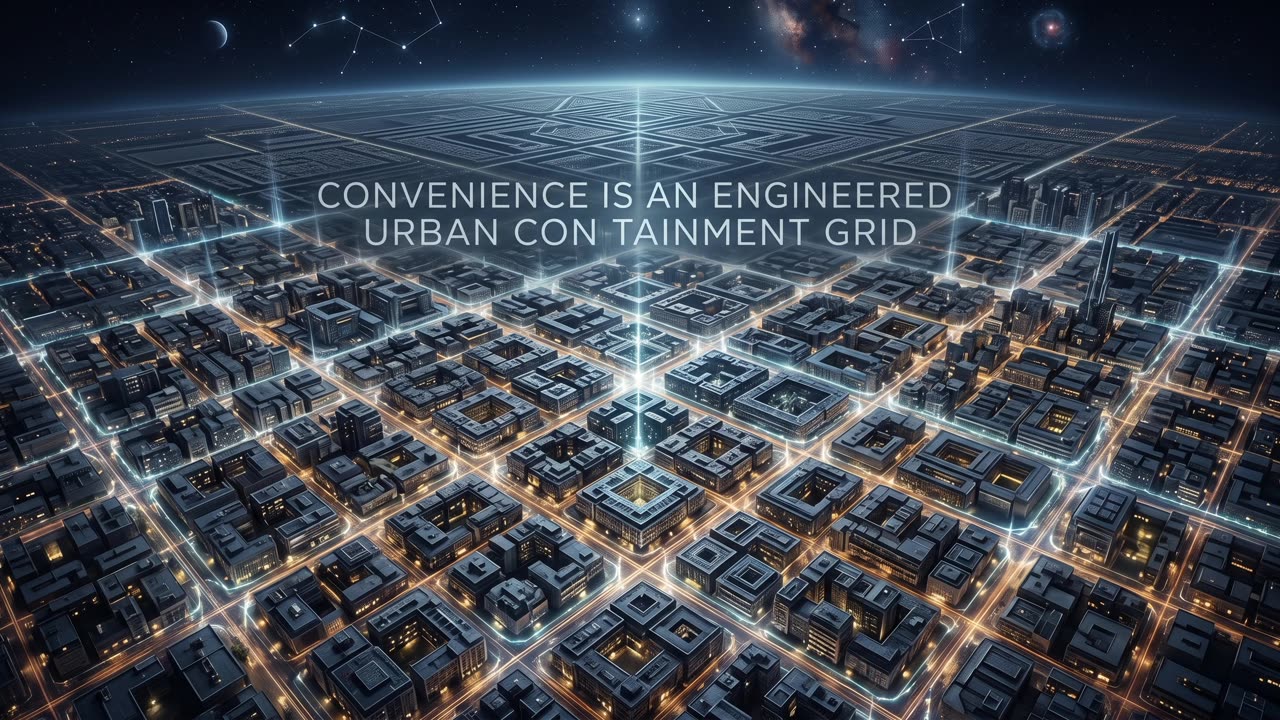
Convenience is an engineered urban containment grid — the easy-option lifestyle trades autonomy for ease and prepares a fully enclosed existence.
 Original transmissions →
Fifteen-Minute Cities are urban containment zones deployed under the cover of public safety, urban efficiency, and walkable convenience. While presented as modern utopias designed to declutter hectic lives, their true operational function is physical containment, total population surveillance, and systemic movement restriction. Through a long-term strategy of incremental acclimatization, the target population is systematically conditioned via manufactured wants, choice architecture, and the easy-option lifestyle to accept these restricted environments voluntarily.
The deployment of Fifteen-Minute Cities represents the physical manifestation of long-term psychological conditioning. The underlying blueprint relies on the understanding that high-density human intelligence cannot be contained by raw force alone without triggering civil revolt. Instead, the Human Farm management team constructs environments supplied with endless entertainment, consumer goods, and artificially constructed aspirations to secure voluntary participation.
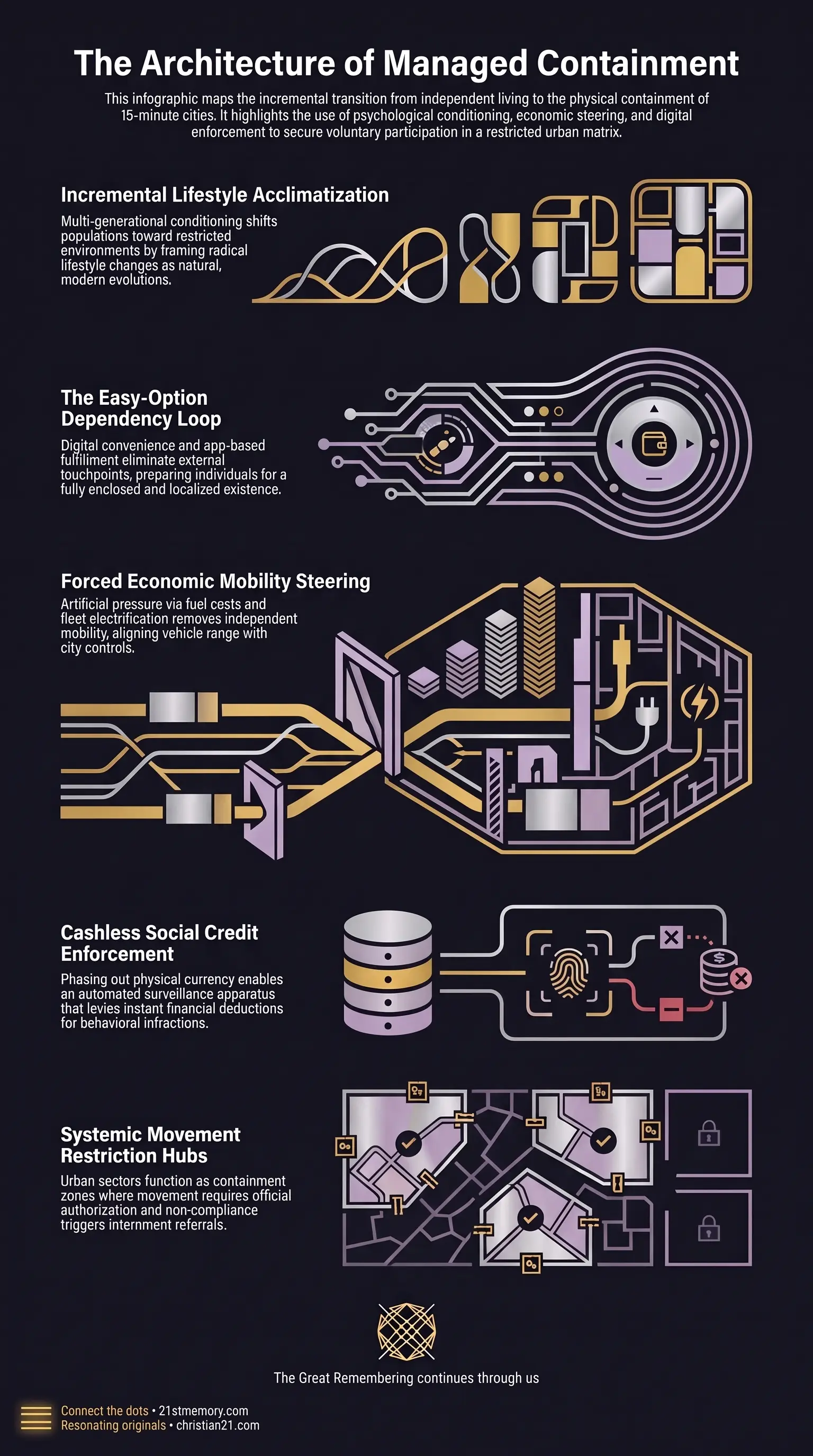
The primary mechanism enabling the seamless adoption of these containment zones is the easy-option lifestyle. Over decades, industrial society has been nudged into abandoning traditional self-reliance—such as weekend routines involving local DIY stores, garden centers, and independent farm shops—in favor of instant digital fulfillment, app-based meal delivery, and Prime shipping. This shift is not intended to simplify life, but to eliminate external touchpoints and prepare the populace for a fully enclosed, localized existence.
Abrupt displacement into a physical enclosure would immediately expose the parasitic nature of the control system. If individuals received an unexpected Compulsory Land Purchase notice stripping them of their ancestral or private homes without prior conditioning, public alarm would ignite immediate resistance. Incremental acclimatization solves this problem for the operators by slowly normalizing the exact conditions required for urban confinement.
The construction of Fifteen-Minute Cities relies on a multi-stage process of behavioral engineering, economic coercion, and environmental manipulation. At the core of this engineering is choice architecture, which bombards individuals with dozens of options for mundane items—such as nineteen variations of coffee, endless brands of shampoo, and complex financial tiers—to absorb mental bandwidth and create the illusion of personal sovereignty. While individuals believe they are expressing personal freedom through consumer selection, their choices remain strictly bounded within a pre-designed matrix of options.
Economic steering acts as a major catalyst in guiding the population toward containment. Systemic price hikes on traditional fossil fuels are deliberately orchestrated to make combustion-engine ownership financially unviable. This artificial pressure forces families to select an electric vehicle under the impression that it is a practical economic decision. Within five years, widespread fleet electrification removes independent, long-distance mobility, aligning vehicle range and grid connectivity directly with the digital controls of urban containment hubs.
The transition from physical currency to a cashless society constitutes the primary enforcement apparatus within the city perimeter. Cash is systematically phased out under the banner of convenience and public safety, eliminating independent commerce and tax-free transactions. Financial worth is then converted into a Social Credit Score System governed by corporate and administrative Acts, Statutes, and Policies.
Daily life inside the Fifteen-Minute City is subjected to automated surveillance and immediate penalization. Routine activities are monitored for minor infractions, such as sitting on a public bench to rest during high heat, which is reclassified as "loitering in public". Police forces and automated systems enforce these rules through:
Fifteen-Minute Cities interconnect directly with the broader framework of manufactured wants and consumer steering. The structural dependency built through online platforms—such as Temu, Wish, Alibaba, DHGate, Amazon, eBay, SHEIN, Uber Eats, Deliveroo, and Just Eat—serves as the digital precursor to localized urban fulfillment.
This containment model also links to legal capture mechanisms, specifically the Maritime Admiralty jurisdiction and the Cestui Que Vie trust structure, which treat private land titles as government-held collateral subject to sudden reclamation. Furthermore, the physical containment provided by these cities works in tandem with FEMA camps, establishing a dual-tier system of local open-air confinement and closed internment for non-compliant individuals.
The ultimate consequence of accepting the Fifteen-Minute City model is the total surrender of physical mobility, economic independence, and personal sovereignty in exchange for artificial convenience. By permitting the elimination of cash and the replacement of organic community trade with algorithmic supply lines, the population accepts a state of permanent, salvation-less enslavement disguised as modern efficiency.
Recognizing the operational trajectory of incremental acclimatization allows individuals to identify the subtle steering mechanisms embedded in daily life. Mitigating this trajectory requires rejecting artificial dependencies, preserving physical assets and independent trade, and recognizing that public convenience initiatives routinely mask long-term containment infrastructure.
This topic is free to share. Support the archive →