Architecture of Emotion
Architecture of Emotion — Engineered auditory frequencies, musical arrangements, and visual sequences that dictate emotional states without conscious awareness.
Emotional scoring is the systematic deployment of engineered auditory frequencies, musical arrangements, and visual scene sequences designed to directly manipulate human cognitive function, alter brain chemistry, and hone targeted emotional responses.
Test your understanding of Emotional Scoring — how engineered auditory frequencies, tempos, and visual sequences dictate emotional states and steer behavior.
Architecture of Emotion — Engineered auditory frequencies, musical arrangements, and visual sequences that dictate emotional states without conscious awareness.

How acoustic priming hijacks your biology — Tempos, timbres, and frequencies that force involuntary grief, panic, and defensive nervous-system reactions.
 Original transmissions →
Emotional scoring is the systematic deployment of engineered auditory frequencies, musical arrangements, and visual scene sequences designed to directly manipulate human cognitive function, alter brain chemistry, and hone targeted emotional responses. Rather than acting as benign background entertainment, score engineering functions as an active mechanism of acoustic priming, infiltrating the human subconscious to dictate emotional states without conscious awareness. By pairing structured visual stimuli with specific acoustic attributes, emotional scoring pre-conditions individuals to experience tailored feelings—ranging from grief, sorrow, and isolation to rage, panic, and aggressive tension—thereby steering behavioral outputs across mass populations.
Operating through film, television broadcasts, advertisements, and public media, this methodology relies on calculated shifts in tone, frequency, and tempo to swamp internal thought mechanisms. Acoustic compositions mimic the fundamental physical characteristics of human vocal and physiological distress, forcing an immediate, involuntary empathetic or defensive nervous system reaction. Through continuous application, emotional scoring functions as a primary driver of subconscious psychological alignment, modulating individual and collective mood states to suit overarching systemic requirements.
Auditory frequencies directly modify neurological chemistry, allowing sound arrangements to elicit specific emotional and behavioral manifestations including rage, sorrow, guilt, anxiety, or violence. Music is treated by system operators not as an artistic medium, but as an energetic weapon deployed against human consciousness to alter brain state dynamics. By transmitting specific acoustic waveforms, operators can bypass critical intellectual filters and directly command the physiological register of the listener.
Broadcast media serves as the public distribution vector for this psychological conditioning, utilizing visual and musical programming to establish collective emotional baselines. While public media uses subtle, broad-spectrum scoring to guide mass consumer and social behaviors, extreme iterations utilize severe, traumatic emotional cycling—oscillating rapidly between extreme distress and artificial affection—to break and compartmentalize individual human minds.
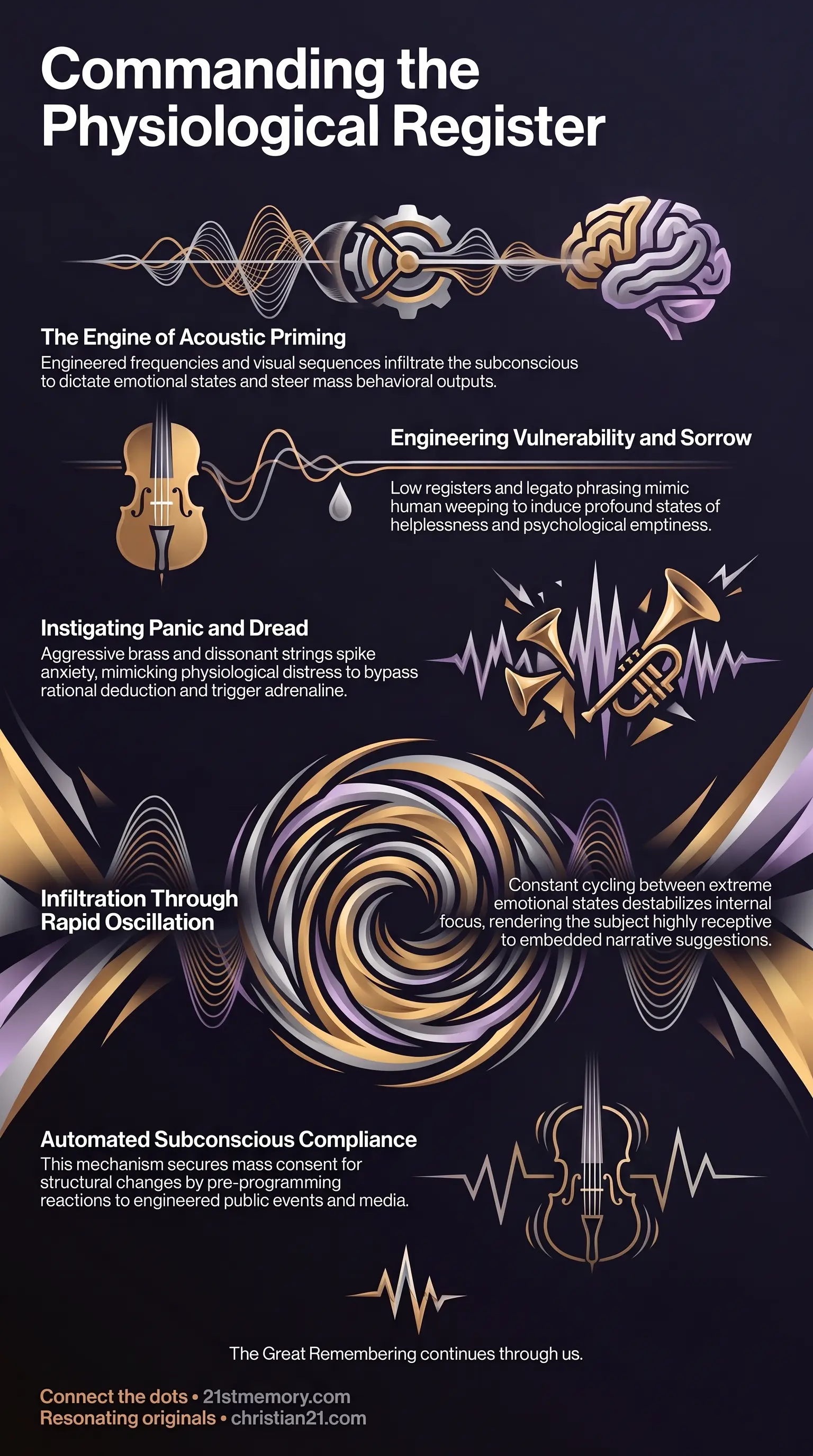
The physical construction of film scores deliberately mimics human physiological vulnerability. Instruments are selected and performance techniques are forced into configurations that mirror human weeping, hyperventilating, or racing heartbeats, triggering hardwired biological responses in the audience that bypass rational deduction.
To induce states of profound grief, sorrow, helplessness, and emotional vulnerability, compositions utilize slow, elongated tempos marked as adagio or largo. Notes are executed using legato phrasing, ensuring seamless transitions without sharp breaks, thereby mimicking the auditory cadence of a human moan or sigh. The overall sonic profile is intentionally hushed, dark, and muted, strictly avoiding sudden volume spikes to maintain an intimate, heavy emotional burden on the listener.
Harmonically, these compositions rely heavily on minor scales and unresolved chords, which generate a persistent state of internal instability, emotional longing, and psychological emptiness. Specific instruments are selected based on their capacity to resonate with the timbre and pitch of human vocal suffering:
The Cello: Serves as the primary instrument for invoking deep grief due to its woody, low-frequency register, which directly matches the pitch range of a somber, weeping voice.
The Solo Violin: Utilizes heavy vibrato to create an unstable, piercing, and fragile acoustic signature that resembles a voice cracking under extreme emotional duress.
The Piano: Employs sparse, soft, and echoing note structures to cultivate feelings of stark isolation, emptiness, and nostalgic longing.
Woodwinds (Oboe, English Horn, Armenian Duduk): Feature reedy, breathy, and nasal qualities; the Armenian duduk in particular is deployed to signal total tragedy and desolate loss.
When the objective shifts to instigating panic, physical dread, adrenaline release, and violent tension, score construction shifts to chaotic, high-energy acoustic triggers designed to agitate the nervous system:
Heavy Percussion (Timpani, Taiko Drums, Anvils): Boom in loud, unrelenting rhythmic patterns that forcefully synchronize with or accelerate the listener's heart rate, imitating heavy footsteps or impending physical danger, while struck metal creates a harsh industrial edge.
Aggressive Brass (Low Trombones, Tubas, French Horns): Blown with the cuivré technique to produce a roaring, brassy menace that signals overwhelming power and inescapable doom.
Dissonant Strings: Abandon smooth melodies in favor of frantic, screeching passages played sul ponticello (bowing extremely close to the instrument's bridge), generating a rasping, glassy noise that directly spikes biological anxiety.
Synthesizers and Sub-Bass: Emit ultra-low-frequency electronic drones that physically vibrate the listening environment, triggering a primal, instinctual sense of dread.
At a structural level, media programming subjects the viewer's cognitive architecture to rapid, alternating emotional inputs. Sequences cycle continuously through contrasting emotional states—happy, sad, cute, funny, sad, happy—to overstimulate the emotional centers of the brain. This rapid alternation breaks down psychological equilibrium and destabilizes internal focus, rendering the subject highly receptive to embedded narrative suggestions.
In extreme, targeted applications, this emotional cycling is amplified to severe extremes under high-stress conditions. Violent trauma and physical abuse are systematically interspersed with periods of intense positive reinforcement, sweets, and false affection. This severe emotional oscillation causes the mind to fracture into distinct compartmentalized personalities, which can later be accessed or activated remotely using specific acoustic triggers, such as a localized radio tune or a single spoken word over a telephone line.
Emotional scoring operates as a key component within a broader framework of environmental distraction and bandwidth reduction. By swamping internal thought processes with continuous, designed external stimuli, operators reduce the individual's capacity to find mental peace or contemplate true reality. This artificial ambient noise keeps consciousness occupied with daily minutiae, preventing critical questioning of societal structures.
Furthermore, public emotional scoring works in tandem with display screen technology designed to manipulate human physiology. Displays can emit pulsed electromagnetic fields and low-frequency visual flickers (such as 0.5 Hz or 2.4 Hz) to induce sensory resonance, causing drowsiness, altered nervous system states, and heightened suggestibility in the viewer while the score manipulates emotional alignment.
On an institutional level, candidates identified through early-childhood screening frameworks—such as specialized Gifted and Talented (G.A.T.) programs established under national security directives—are funneled into specialized operational pipelines. These individuals are subjected to advanced acoustic and psychological conditioning, turning them into trigger-responsive assets while the broader public remains pacified by broad-spectrum media scoring.
The widespread implementation of emotional scoring ensures that mass populations remain in a state of subconscious emotional compliance, responding predictably to engineered public events and media narratives without requiring direct physical force. By pre-programming public emotional reactions to tragic or violent events, operators can easily secure consent for legal updates, regulatory shifts, and structural societal changes.
Additionally, the ability to modify neural chemistry through ambient sound arrays creates an automated mechanism for population control. Mass audience members are primed to experience pre-selected emotional states, ensuring that public consensus, consumer desire, and political allegiance are effortlessly directed while individual internal awareness remains thoroughly suppressed.
This topic is free to share. Support the archive →