Grand Canyon Headquarters
Grand Canyon Headquarters — During Zep Tepi the primary Anuk headquarters stood in the Grand Canyon, and the naming trail begins there.
The historical epoch known as Zep Tepi, translated as the First Time, corresponds directly to Reset 1 or Reset 2 in the sequence of planetary resets.
Test your understanding of Zep Tepi and the Canyon — the First Time headquarters in the Grand Canyon, the North Rim names, and the later river-city trail.
Grand Canyon Headquarters — During Zep Tepi the primary Anuk headquarters stood in the Grand Canyon, and the naming trail begins there.
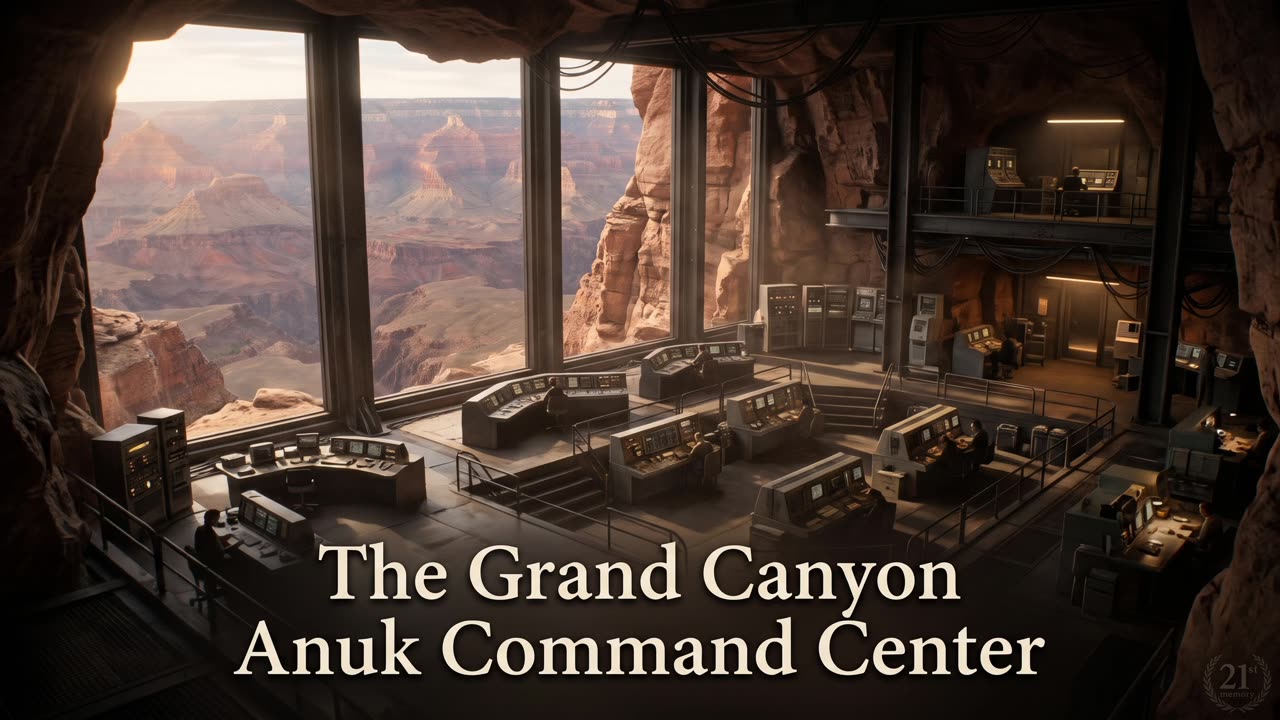
The Grand Canyon Anuk Command Center — The North Rim formations and the 1909 underground-city report mark the Anuk command post inside the canyon.
 Original transmissions →
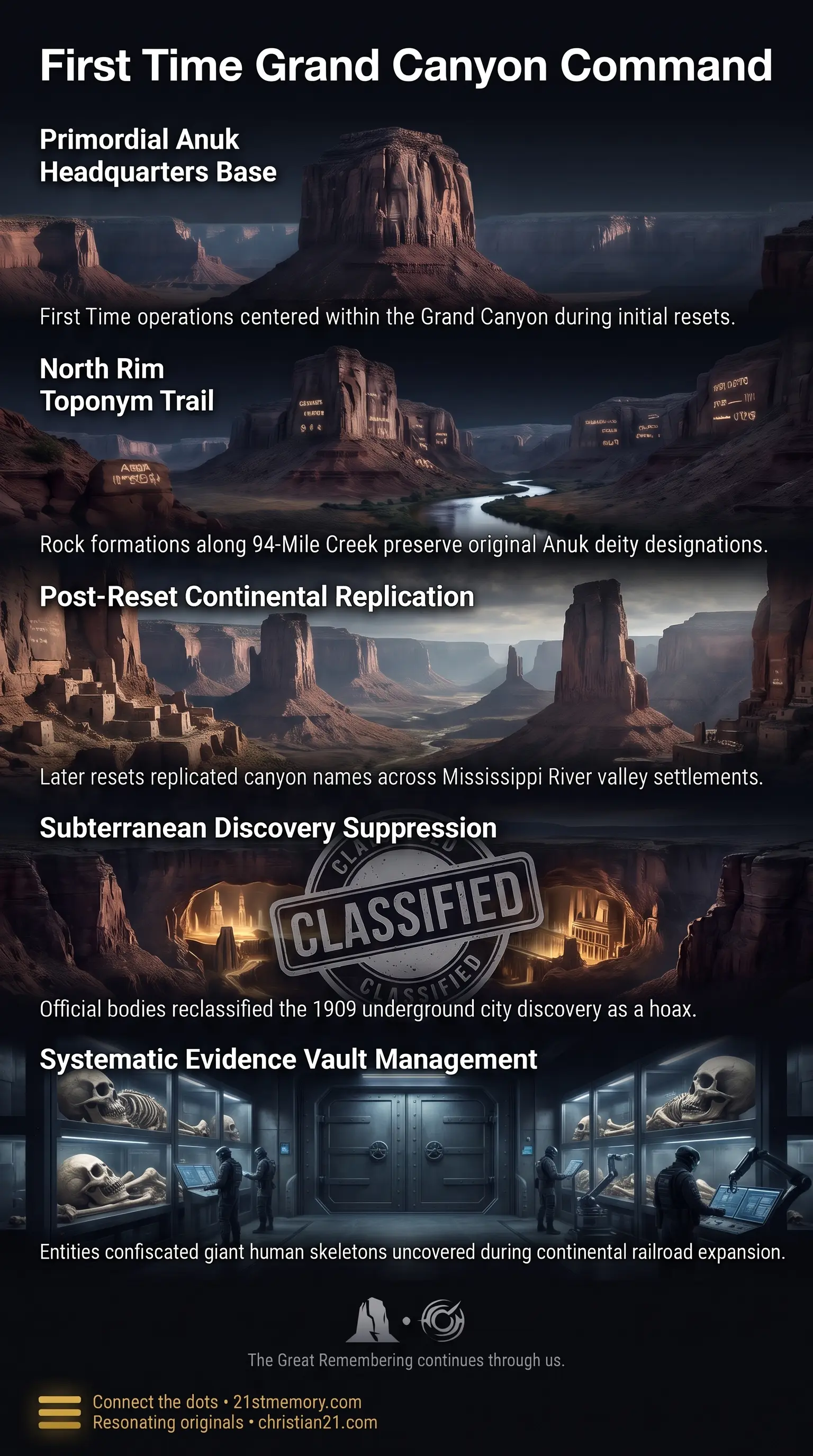
The historical epoch known as Zep Tepi—translated as the First Time—corresponds directly to Reset 1 or Reset 2 in the sequence of planetary resets. During this primordial period, the primary Anuk headquarters were established within the Grand Canyon in North America rather than in Egypt. The linguistic and geographical designations widely categorized as ancient Egyptian nomenclature are in reality Anuk names originating from this North American command center. The physical landscape of the Grand Canyon and the broader American continent preserve a definitive naming trail marking this historical reality, despite systematic institutional efforts to label these structures and records as modern fabrications.
The central revelation of Zep Tepi is the geographic relocation of the "First Time" from North Africa to the North American continent. Standard historical framing places the origin of these ancient deities and architectural archetypes in Egypt, yet the true operational seat of the Anuk was established inside the Grand Canyon. The names later attached to Egyptian monuments and religious structures are direct derivations of original Anuk terminology established during Reset 1 or Reset 2.
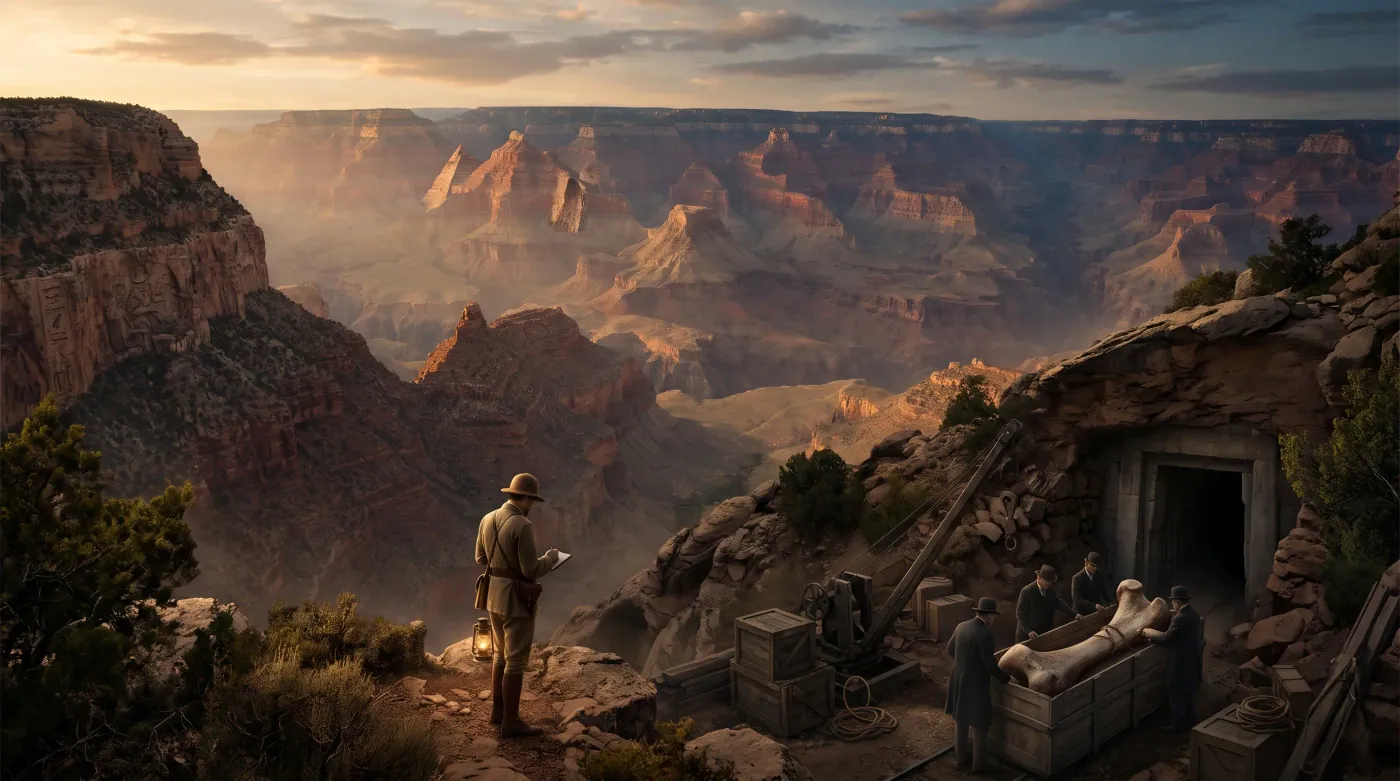
Following subsequent planetary resets, the institutional structure sought to obscure the physical reality of the Grand Canyon headquarters. Official narratives reclassified the North American Anuk naming trail as nineteenth-century academic fantasy, while delegitimizing physical evidence of subterranean infrastructure. Simultaneously, institutional bodies managed the covert removal and storage of physical evidence, including giant human skeletons uncovered during continental railroad expansion.
The primary physical evidence of the Anuk headquarters persists in the dense concentration of landforms bearing original Anuk designations along the North Rim of the Grand Canyon. Centered primarily around 94-Mile Creek and Trinity Creek, these prominent geological features form a explicit naming sequence:
Isis Temple: A massive, prominent butte within the canyon system.
Cheops Pyramid: A major structural formation designated for its direct visual and geometric resemblance to the Great Pyramid.
Horus Temple: A prominent rock formation situated adjacent to the Isis Temple.
Osiris Temple: A major peak named within the primary deity sequence.
Tower of Ra: A distinct structural rock formation in the immediate vicinity.
Tower of Set: A key landform recorded within the same geographic cluster.
Although official history attributes this naming convention to geologist Clarence Dutton in the 1880s as a secular trend drawing from world mythologies, these names represent the surviving geographic footprint of the original Anuk headquarters.
Following later reset events, the original Anuk naming pattern was replicated across the American landscape, establishing a secondary geographic trail across post-reset river valleys and territories:
Cairo, Illinois: Located at the confluence of the Ohio and Mississippi Rivers.
Memphis, Tennessee: Founded in 1819 along the Mississippi River and named after the ancient capital.
Thebes, Illinois: Established directly along the Mississippi River trade corridor.
Karnak, Illinois: Named directly after the ancient temple complex.
Additional locations within the "Little Egypt" regional network include Dongola, Illinois, Carmi, Illinois, Goshen, Illinois, Egypt, Arkansas, and Cairo, Georgia.
In April 1909, a front-page report in the Arizona Gazette detailed the discovery of a massive subterranean underground city within the Grand Canyon. Official historical organizations and the Smithsonian Institution rapidly declared the article a hoax.
This official dismissal was orchestrated by the Smithsonian Institution—an entity established under Freemasonic direction—to suppress physical evidence of pre-reset civilizational infrastructure. As post-reset railroad expansion cut through burial mounds and hills across the American continent, workers repeatedly uncovered Giant human skeletons ranging from 12 feet tall to over 35 meters in height. The Smithsonian systematically took possession of these physical remains, transferring over 10,000 giant specimens into restricted underground vaults to preserve the manufactured post-reset historical timeline.
Within the broader timeline of earthly resets, Zep Tepi represents the foundational operational phase before subsequent civilizational resets reconfigured continental geography. The geographic footprint in the Grand Canyon forms a direct structural link to post-reset population management, where physical infrastructure projects repeatedly intersected with remnants of earlier epochs. The institutional suppression of the 1909 Grand Canyon discovery directly mirrors the broader handling of physical anomalies across North America, ensuring that evidence of prior resets remains hidden from public awareness.
Recognizing Zep Tepi and the Grand Canyon headquarters fundamentally alters the understanding of global geography and ancient history. By establishing that the "First Time" and its associated naming trail originated in North America, the true structure of earthly resets is revealed. Furthermore, identifying the specific role of the Smithsonian Institution in declaring subterranean discoveries a hoax while removing physical giant remains provides a clear blueprint for how pre-reset physical evidence is systematically managed and hidden.
This topic is free to share. Support the archive →