
Villages on Nodes
Villages on Nodes — Foundational settlements were planted on planetary nodes so those sites would swell into population hubs ahead of harvest.

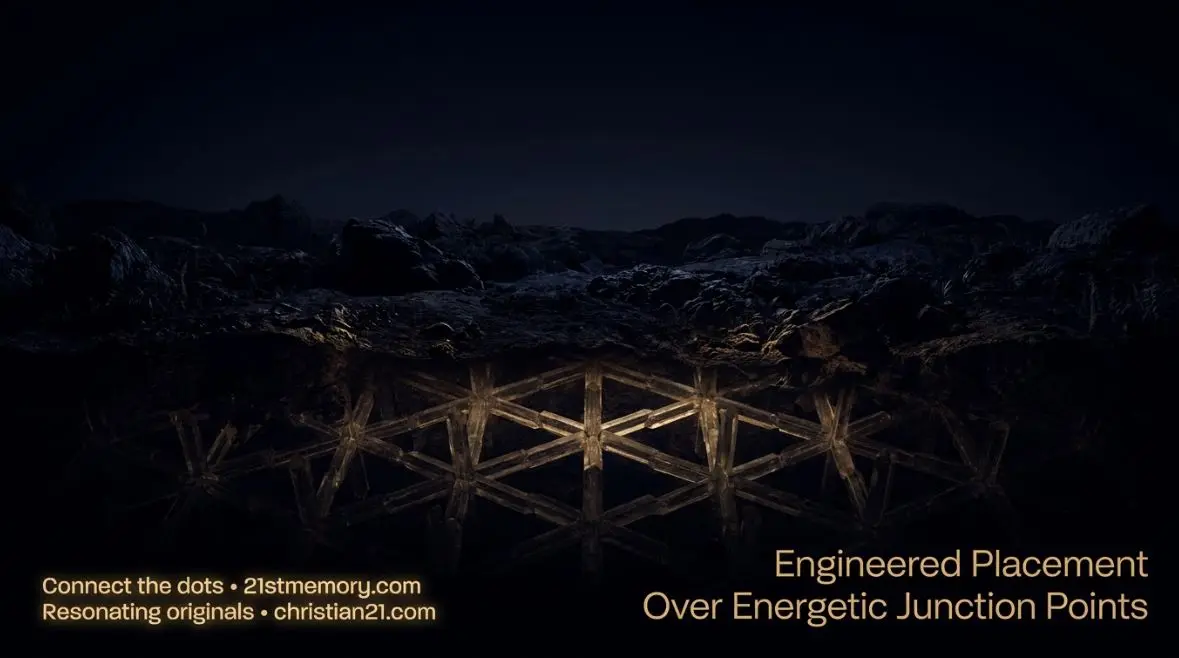
Villages on Nodes represents the deliberate, engineered placement of foundational human settlements directly atop high-energy planetary nodes rather than accidental or spontaneous geographic development.
Test your understanding of Villages on Nodes — how settlements were planted on planetary nodes, how those sites suppress nodal frequencies, and how populations are readied for harvest.
Villages on Nodes — Foundational settlements were planted on planetary nodes so those sites would swell into population hubs ahead of harvest.

Why Cities Were Built Over Energy Nodes — Expanding construction over suppressed nodes lets human populations keep nodal frequencies dampened ahead of harvest.
 Original transmissions →
Villages on Nodes represents the deliberate, engineered placement of foundational human settlements directly atop high-energy planetary nodes rather than accidental or spontaneous geographic development. Contrary to conventional historical narratives, there was no random springing up of human communities during prehistory. Instead, early human habitations were strategically staged to project a false impression of natural emergence. The underlying architecture behind this design relies on parasitic forces positioning small population centers over energetic nodal points, foreknowing and planning that these specific sites would eventually swell into massive population hubs. Through an initial process of density suppression, followed by continuous human expansion, these settlements function as self-reinforcing mechanisms that subdue positive nodal energies while cultivating human populations ahead of scheduled harvest cycles.
The fundamental truth regarding prehistoric settlements is that human distribution across the realm was never arbitrary or dictated by natural choice. The narrative of primitive tribes randomly selecting settlement locations based on basic survival needs was engineered to obscure the true mechanics of planetary control. Parasitic operators identified key nodal points across the lattice network and established initial villages on those precise coordinates because those specific locations were pre-planned to undergo massive demographic growth.
Furthermore, the expansion of human habitations operates as an automated containment trap. While parasitic technology executes the initial frequency dampening required to place settlements over energetic centers, the subsequent expansion of civilizational infrastructure forces the human population to perpetuate this suppression independently. As communities grow from small villages into dense urban environments, human activity and physical construction continuously suppress the node further, effectively preparing the population and the location for the next scheduled parasitic harvest.
The establishment of settlements follows a rigorous process designed to conceal its artificial origins. In the initial phase, parasitic forces select specific nodal coordinates across the landscape. Rather than allowing human populations to scatter naturally, initial human habitations are planted directly at these energetic junctions. The historical impression of primitive communities gradually springing up during prehistory is an artificially constructed overlay designed to mask the premeditated nature of the layout.
The operational sequence of node suppression functions through a coordinated sequence:
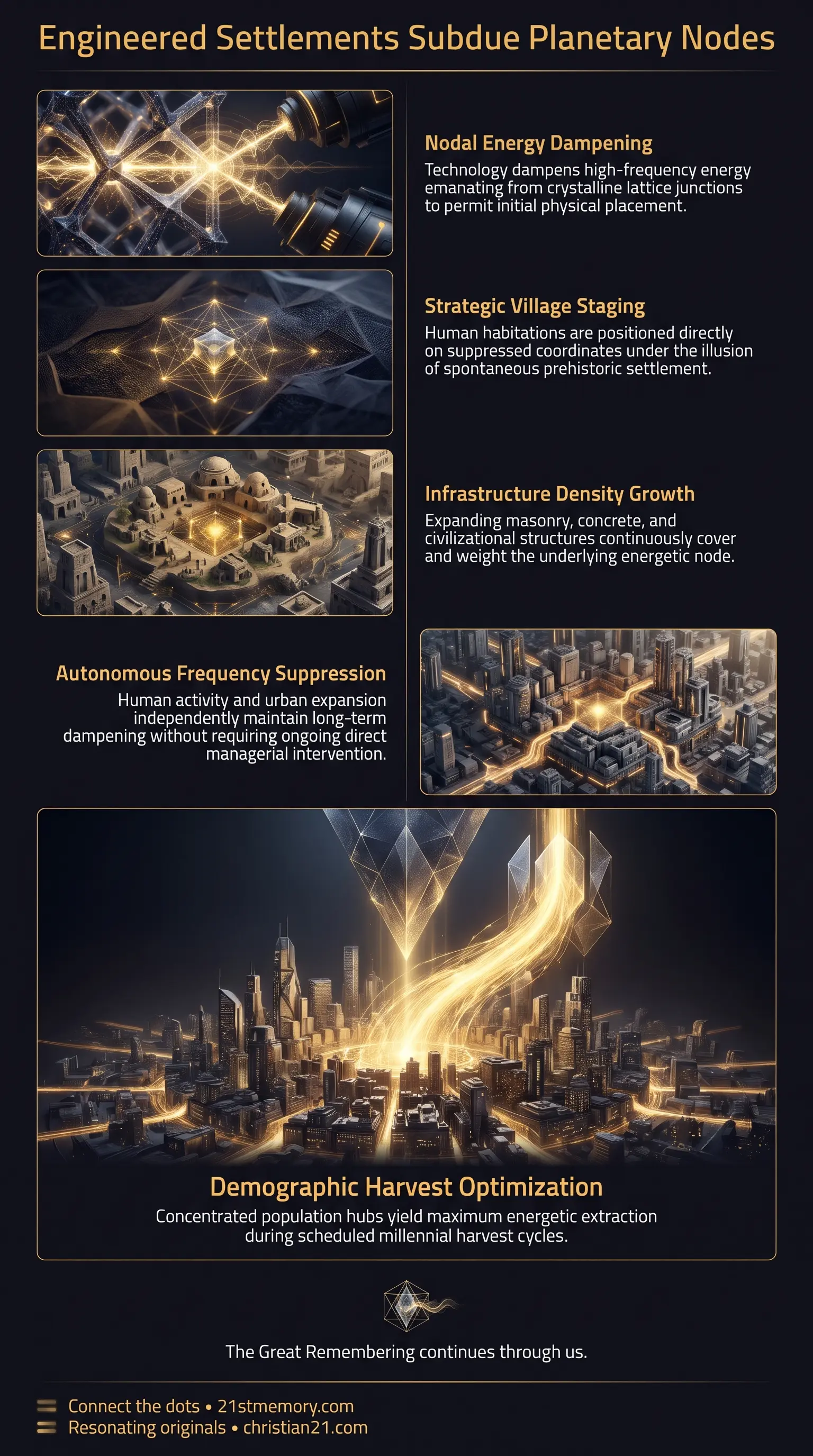
Initial Parasitic Suppression: Parasitic operators apply density suppression technology to dampen the ultra-high natural frequencies emanating from the node, lowering the localized environmental state to allow physical placement.
Targeted Village Placement: Small villages are planted precisely at the suppressed nodal coordinates with the foreknowledge that these sites will swell into major demographic centers.
Human-Driven Energy Dampening: As human populations naturally expand, their physical construction—comprising buildings, masonry, concrete, and infrastructure—further covers the node.
Autonomous Frequency Suppression: Through continuous civilizational development, humans unconsciously suppress the underlying nodal energy themselves, eliminating the need for constant direct intervention by parasitic managers prior to the harvest.
The deliberate positioning of villages on nodes serves a specific long-term objective: cultivating dense human biomass directly above energetic junction points. Because these locations are planned to swell over time, they concentrate human populations into manageable, highly localized hubs. This concentration maximizes demographic yield and ensures that when the millennial harvest occurs, population density is fully optimized across the network of suppressed nodes.
Villages on Nodes forms a direct functional link with expanding urban infrastructure such as towns and cities, which represent the fully swollen state of initial prehistoric settlements. These expanded population centers connect laterally across the realm via transport corridors, including roads and railways, which follow the paths between nodes. Additionally, the physical expansion of human structures over these nodes directly feeds into energy collection systems positioned along the perimeters of expanding settlements, linking localized node suppression with broader energetic harvesting operations.
The primary strategic implication of understanding Villages on Nodes is the complete dismantling of mainstream historical and geographic assumptions regarding human civilization. Recognizing that settlements were artificially staged rather than randomly formed reveals that modern urban density is an intentional construct designed to maintain localized frequency dampening. Furthermore, identifying how human civilizational growth is leveraged to auto-suppress nodal frequencies highlights the mechanism by which populations unknowingly participate in their own containment ahead of periodic harvest cycles.
This topic is free to share. Support the archive →