
Zero Reflection Liquid
Zero Reflection Liquid — Red Mercury has zero optical reflection, is pushed away by a garlic clove, and is drawn toward gold.

Red Mercury represents a specialized, highly complex liquid metal fundamentally distinct from ordinary elemental liquids and conventional furnace mercury.
Test your understanding of Red Mercury — the zero-reflection liquid, the garlic and gold tests, and aerial extraction of subterranean gold.
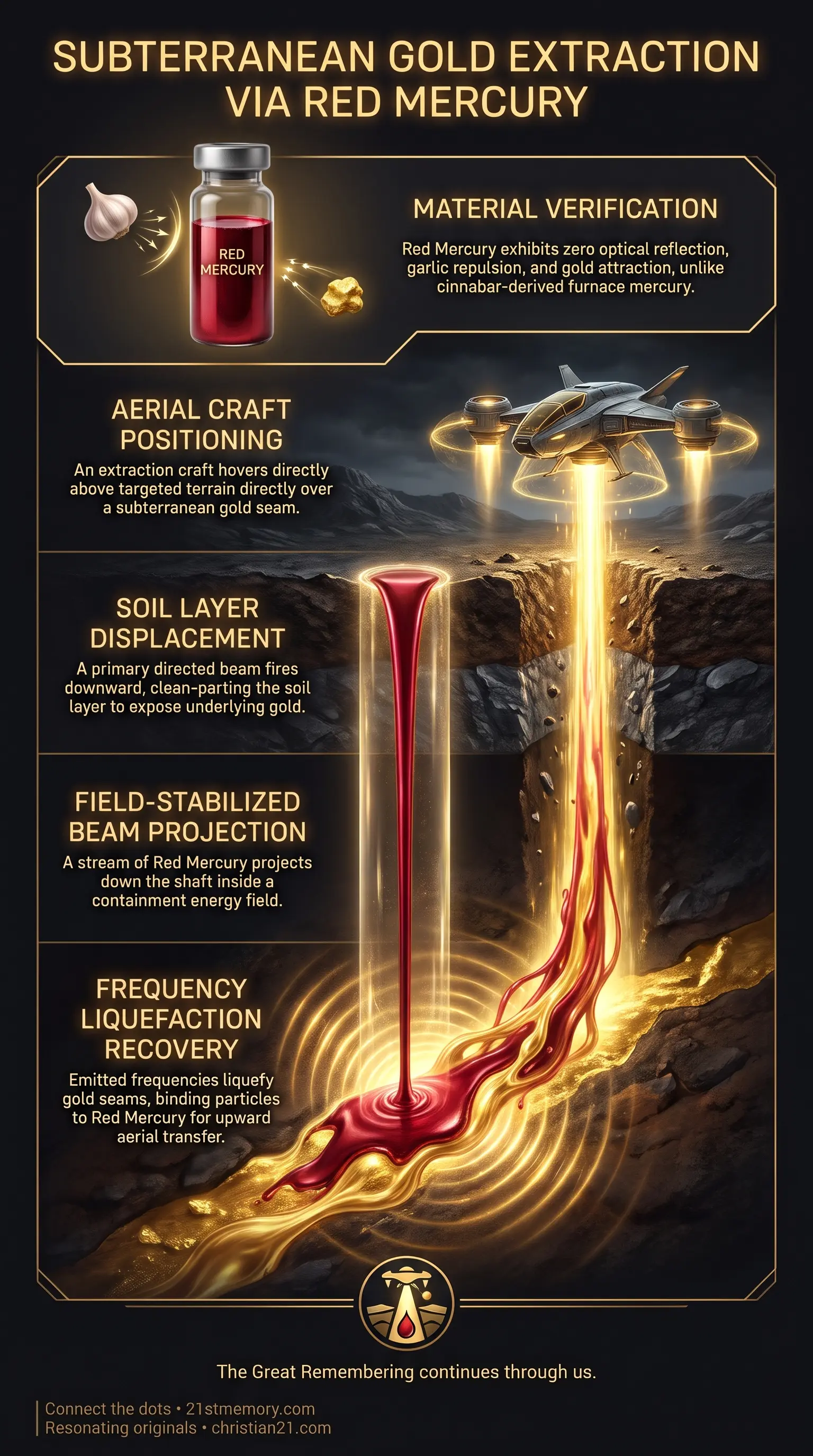
Zero Reflection Liquid — Red Mercury has zero optical reflection, is pushed away by a garlic clove, and is drawn toward gold.

Red Mercury Powered Aerial Gold Extraction — A craft projects Red Mercury down a parted shaft and uses a liquefaction frequency to pull gold upward.
 Original transmissions →
Red Mercury represents a specialized, highly complex liquid metal fundamentally distinct from ordinary elemental liquids and conventional furnace mercury. While standard mercury is derived from the thermal processing of cinnabar ore, Red Mercury exhibits anomalous physical behaviors: it possesses zero optical reflection, is actively pushed away by a garlic clove, and is magnetically drawn toward gold. Rather than serving as a decorative element or simple mineral compound, Red Mercury operates as an active medium in advanced gold extraction technology. Deployed from overhead craft, it is held within a targeted energy field and energized by a liquefaction frequency to pull sub-surface gold seams directly out of the Earth. Legacy published pages and historical reports frequently omitted these defining physical traits—specifically the lack of reflection, the garlic test, and the critical distinction between red ore cinnabar and true Red Mercury—focusing solely on the lifting beam itself.
The primary revelation surrounding Red Mercury resolves a long-standing 40-year enigma regarding anomalous geological formations across South America. Geologists and research teams conducted extensive, costly investigations into arrays of uniform holes laid out in precise patterns across remote South American mountains, misidentifying them as mystery quarries or unexplained manual excavations. Christian's account establishes that these structured hole patterns are not quarries, but the direct structural footprint of directed energy craft performing subterranean gold extraction.
Furthermore, critical details regarding Red Mercury were omitted from earlier published pages. While historical accounts occasionally referenced a red-mercury beam lifting gold, they routinely failed to record its non-reflective nature, its physical repulsion by garlic, and its absolute distinction from ordinary furnace mercury derived from cinnabar. Restoring these missing parameters provides a complete scientific and operational understanding of the substance.
Red Mercury is defined by three precise physical tests that differentiate it from all standard elemental metals:
Non-Reflectivity: Unlike standard liquid mercury, Red Mercury exhibits no optical reflection whatsoever.
Garlic Repulsion: When brought into proximity with a garlic clove, Red Mercury is physically pushed away.
Auric Attraction: When placed near gold, Red Mercury is magnetically drawn toward the gold.
In contrast, furnace mercury is produced through traditional pyrometallurgy: red cinnabar ore is heated to 500 degrees Celsius in the presence of oxygen, condensing into a silver liquid metal that lacks these reactive behaviors.
The deployment of Red Mercury for subterranean gold harvesting follows a precise four-stage operational sequence:
Craft Positioning: An extraction craft hovers directly above the targeted terrain, positioning itself over a subterranean gold seam.
Soil Displacement: The craft fires a primary directed beam downward, clean-parting the soil layer down to the underlying gold layer.
Field-Stabilized Beam Projection: A targeted stream of Red Mercury is projected down the parted shaft, held perfectly stable within a containment energy field to prevent environmental dispersion.
Frequency Liquefaction and Recovery: The Red Mercury beam strikes the gold seam while emitting a specialized liquefaction frequency. This frequency liquefies the gold, allowing the Red Mercury to bind to every particle of gold and draw it upward through the craft's directed energy transfer beam.
The physical footprint of this extraction process accounts for the uniform cylindrical shafts discovered across mountain ranges in South America. Rather than representing manual mining, cutting, or quarrying efforts, each shaft marks a precise location where a craft's directed energy beam penetrated the soil to extract an underlying mineral seam.
Red Mercury operates at the intersection of material chemistry, frequency manipulation, and directed energy engineering. Its reactive behavior toward organic compounds like garlic and precious metals like gold links physical material properties with energetic field dynamics. By integrating liquid metal containment within directed energy transfer beams, this technology bypasses conventional mechanical excavation, converting solid sub-surface seams directly into liquid streams for aerial recovery.
The clarification of Red Mercury mechanics eliminates conventional misconceptions regarding ancient mining and geological anomalies. Recognizing that remote mountain hole arrays stem from field-stabilized energy beams redefines mysterious archaeological sites as industrial extraction zones. Additionally, correcting legacy literature by embedding the non-reflection attribute, the garlic test, and the distinction from cinnabar ensures that future analyses of Red Mercury are grounded in its complete operational profile.
This topic is free to share. Support the archive →